Source eco friendly non toxic jigsaw puzzle for schools, homes, and therapy
Find 24 options for eco friendly non toxic jigsaw puzzle featuring materials like EVA foam and paper with EN71 certification. Compare customization, packaging, and delivery times from suppliers in China and Taiwan to match your educational toy needs.
Key considerations
Products List




Comprehensive Sourcing Guide
Strategic Sourcing Guide for Eco-Friendly Non-Toxic Jigsaw Puzzles
Understanding Product Definitions and Material Variations
When sourcing "eco-friendly non-toxic jigsaw puzzles," buyers must first navigate the significant variance in product definitions found in the current market. The term "jigsaw puzzle" often encompasses distinct categories ranging from traditional flat cardboard puzzles to three-dimensional construction sets and educational foam toys. In the observed product landscape, the core keyword intersects with multiple specific product types, including "3D Puzzle," "Intelligence Toys," and "Educational Cards." A critical distinction lies in the material composition, which directly dictates the eco-friendly and non-toxic claims.
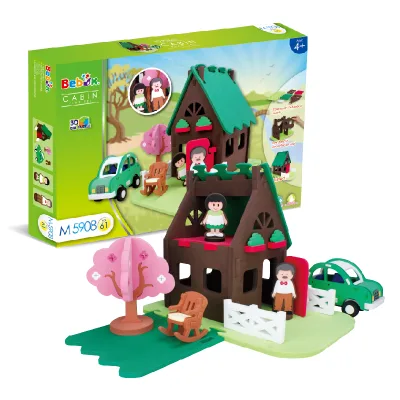
The supply chain presents two primary material profiles for these items. One profile utilizes "EVA Foam" or "EVA" as the primary material, often associated with "DIY Toy" and "Educational Toy" styles. These products frequently feature a piece count ranging from 51 to 100 pieces, with some specific models listing exactly 61 pieces. These foam-based puzzles are often marketed for younger demographics, with age ranges frequently cited as "3-7 Years," "4+," or "5 to 7 years." The alternative profile relies heavily on "Paper" materials, described as "Paper puzzles" or "shaped puzzles," utilizing "Gloss Artpaper," "Artcard," or "Matt Artpaper." These are often categorized under "Language Card" or "Educational Cards" with piece counts of "24 & Under."
Buyers must verify that the specific product listing aligns with the intended use case. A "3D Puzzle" made of EVA foam offers a different tactile experience and durability profile compared to a flat "Paper" puzzle. The "Eco-friendly" attribute in this context is not a universal guarantee but a variable dependent on the specific manufacturer's formulation of the EVA or the sourcing of the paper. Similarly, the "Non-toxic" claim requires rigorous verification against the specific chemical composition of the ink and binding agents used, rather than assuming it applies to all products labeled as "Intelligence Toys."
Compliance Verification and Safety Standards
The safety of toys intended for children, particularly those in the "3-7 Years" or "4+" age brackets, is the paramount concern for any procurement strategy. The observed data explicitly references "EN71" as a certification standard for certain products in the supply chain. EN71 is a European standard for the safety of toys, covering mechanical, physical, chemical, and flammability requirements. When sourcing "non-toxic" items, buyers should prioritize suppliers who can provide valid, up-to-date EN71 test reports.
However, the presence of a certification label does not automatically validate the entire supply chain. The provided facts list "EN71" as a specific attribute for some items but also include a low-confidence background note regarding FSC (Forest Stewardship Council) certification. Buyers should not assume FSC certification is present unless explicitly documented in the supplier's current compliance file. For paper-based puzzles, verifying FSC certification is essential to confirm that the wood pulp or paper fibers originate from responsibly managed forests, which is a core component of the "eco-friendly" definition.
Furthermore, the "Non-toxic" claim must be supported by chemical testing data beyond just the general EN71 standard. Buyers should request specific test reports for heavy metals (such as lead, cadmium, and mercury), phthalates, and formaldehyde, particularly for EVA foam products where plasticizers are commonly used. The observed product attributes mention "EU Environmental Ink" in the context of color customization, which is a positive indicator for eco-friendly sourcing. However, this should be treated as a specific feature of certain listings rather than a blanket standard for all "Jigsaw Puzzle" products. Procurement teams must verify that the "Customized" color options, which may include "Cmyk and/or Pantone Colors," adhere to the same non-toxic thresholds as the standard production runs.
Cost Drivers and Minimum Order Quantities
The pricing structure for eco-friendly jigsaw puzzles is influenced by material costs, customization levels, and order volume. The observed market data indicates a price range of $0.30 to $6.92 USD per unit. This wide variance suggests that cost is heavily dependent on the complexity of the design, the material density, and the packaging type. For instance, products packaged in an "Iron Box" or specialized "Carton" configurations may command a higher price point compared to standard "Box Packing" or bulk shipments.
Minimum Order Quantity (MOQ) is a critical financial constraint in this sector. The observed MOQ range spans from 12 to 1000 sets, with a specific high-confidence fact noting an MOQ of 300 sets for certain models. A significant cost driver is the "Customized Packaging" requirement, which often carries a higher threshold, specifically noted as a "Min. Order: 1000 sets." Buyers seeking to introduce a custom-branded eco-friendly puzzle must budget for this higher volume requirement to achieve the desired branding on the packaging.
Additionally, the "Supply Ability" of the manufacturer plays a role in cost stability. The data indicates a supply capacity of 12,000 sets per month for certain suppliers. While this suggests robust production capabilities, buyers should confirm if this capacity is maintained for custom orders, as eco-friendly materials and non-toxic inks may have longer lead times or require specific production runs that differ from standard inventory. The "Delivery Time" of 15-25 days is a standard baseline, but customizations involving specific "Graphic" or "Logo" printing may extend this timeline. Buyers should factor in these lead times when planning inventory to avoid stockouts, especially for seasonal product launches.
Technical Specifications and Customization Capabilities
Technical specifications for jigsaw puzzles vary significantly based on the intended educational or recreational application. The product attributes highlight several key technical variables that buyers must evaluate. The "Number of Puzzle Pieces" is a primary differentiator, with observed ranges from "24 & Under" for card-based learning tools to "51~100" for standard puzzles, and specific models like "M5908" offering 61 pieces. The choice of piece count directly impacts the difficulty level and the target age group, which must align with the "Age Range" specifications of 3-7 years or 4+.
Customization is a central feature of the modern puzzle market, with "Customization" listed as "Available" across the board. The specific customization services include "Customization Graphic," "Logo," and "Packaging." For buyers focusing on the "Eco-friendly" aspect, the customization process must ensure that the added graphics and logos do not compromise the non-toxic nature of the product. The "Surface Finishing" options, such as "Lamination," "Varnishing," "Gold/Silver Foil," and "Hot Stamping," introduce additional material layers. Buyers must verify that these finishing processes use eco-friendly adhesives and inks to maintain the product's environmental profile.
The "Model Number" and "Product Name" (e.g., "Intelligence Toys") serve as identifiers for specific technical configurations. The "Style" is described as "DIY Toy," "Educational Toy," or "Educational Cards," indicating the functional design. For "3D Puzzle" types, the structural integrity and the method of assembly are critical technical factors. The "Material" is consistently noted as "EVA" or "Paper," but the specific density and thickness of these materials are not always detailed in the summary attributes. Buyers should request detailed technical datasheets to confirm the thickness of the paper or the density of the EVA foam, as these factors influence the durability and the "non-toxic" safety profile of the final product.
Supplier Evaluation and Quality Assurance Protocols
Evaluating suppliers for eco-friendly jigsaw puzzles requires a multi-faceted approach that goes beyond basic product listings. The "Place of Origin" is listed as "China" and "Taiwan," with a "Port of dispatch" at "KAOHSIUNG." While these locations indicate established manufacturing hubs, buyers must conduct on-site audits or third-party inspections to verify the actual production environment. The presence of a "Brand Name" such as "Bebox" suggests that some suppliers operate under their own branding, which can be an advantage for buyers seeking established quality control systems.
Quality assurance protocols should focus on the consistency of the "Non-toxic" claims. Since the "Certificate" field lists "EN71," buyers should demand that the supplier provides the full test report from an accredited laboratory, not just a certificate number. The "Standard" is listed as "Customized" or "Standard," which implies that the production process can be adapted. However, for eco-friendly claims, the "Standard" should ideally align with international environmental management systems. Buyers should inquire about the supplier's internal quality control measures regarding ink safety and material sourcing.
The "Selling Units" are listed as "Single item," which may indicate that the supplier is capable of handling small sample orders or drop-shipping scenarios. However, for bulk procurement, the "Supply Ability" of 12,000 sets per month must be validated against the buyer's volume requirements. A robust supplier evaluation should also include a review of the "Main Accessories" list, which includes items like "Head Band," "Ribbon Marker," and "Eyelet." These accessories must also be non-toxic and safe for the target age group, as they are often included in the final package.
Long-Term Procurement and Market Trends
Long-term procurement of eco-friendly jigsaw puzzles requires a strategic view of market trends and supply chain resilience. The "Eco-friendly" and "Non-toxic" attributes are no longer niche preferences but are becoming baseline expectations for educational toys and children's products. Buyers should anticipate increasing regulatory pressure regarding chemical safety and environmental sustainability. The current market data shows a trend toward "Customized" packaging and "Graphic" customization, suggesting that branding and educational value are key differentiators.
To maintain a competitive edge, buyers should consider the "Educational Toy" aspect of the product. Products labeled as "Intelligence Toys" or "Educational Cards" often have higher perceived value and repeat purchase potential. The "Age Range" of 3-7 years represents a critical developmental stage, and products that effectively support learning through play are likely to have sustained demand. Buyers should evaluate the supplier's ability to innovate within the "DIY Toy" and "3D Puzzle" categories to keep the product line fresh and engaging.
Furthermore, the "Lead Time" of 15-25 days and the "MOQ" of 300 to 1000 sets suggest that buyers need to plan their inventory cycles carefully. Establishing a long-term partnership with a supplier who can consistently meet these volume and timeline requirements is essential. Buyers should also monitor the "Port of dispatch" and logistics capabilities to ensure that the "Eco-friendly" claims are not compromised by excessive packaging or inefficient shipping methods. The ultimate goal is to build a supply chain that delivers high-quality, safe, and sustainable products while maintaining cost efficiency and operational reliability.
Comparative Analysis of Product Attributes
To assist in the decision-making process, the following table summarizes the key technical and commercial attributes observed in the market for eco-friendly jigsaw puzzles. This comparison highlights the diversity of options available and the specific verification points required for each category.
| Attribute Category | EVA Foam / 3D Puzzle Profile | Paper / Card Puzzle Profile | Verification Requirement |
|---|---|---|---|
| Primary Material | EVA Foam, EVA | Paper, Artpaper, Artcard | Confirm material safety data sheets (MSDS). |
| Piece Count | 51~100 (e.g., 61 pcs) | 24 & Under | Verify piece count matches age appropriateness. |
| Target Age | 3-7 Years, 4+, 5-7 Years | 3 & Above | Ensure age rating aligns with safety standards. |
| Packaging | Iron Box, Carton, Box Packing | Box Packing | Check for eco-friendly packaging materials. |
| Certification | EN71 (Observed) | EN71 (Observed) | Request full EN71 test reports. |
| Customization | Graphic, Logo, Packaging | Graphic, Logo, Packaging | Verify ink safety for custom colors. |
| MOQ | 300 sets (Standard), 1000 (Custom) | 12-1000 sets | Confirm MOQ for custom branding. |
| Lead Time | 15-25 Days | 15-25 Days | Plan for potential delays in custom runs. |
This comparative view underscores that while the core keyword "eco-friendly non-toxic jigsaw puzzle" unifies the product category, the execution varies widely. Buyers must carefully match the specific product profile to their brand values and customer expectations, ensuring that every claim is backed by verifiable data.
FAQs
What certifications verify non-toxic safety for these puzzles?
EN71 certification verifies non-toxic safety for specific puzzle models in this supply chain. Buyers must request valid test reports from accredited laboratories to confirm compliance with European toy safety standards before procurement.
Which materials are used for eco-friendly jigsaw puzzles?
Products primarily use EVA foam or paper materials depending on the design type. EVA foam is common for 3D puzzles while paper is used for flat cards, requiring verification of ink safety for each material profile.
How does customization affect minimum order quantities?
Customized packaging requires a minimum order of 1000 sets for most suppliers. Standard orders may start at 300 sets, but adding logos or graphics typically triggers the higher volume threshold to cover production setup costs.
What is the typical delivery time for these items?
The standard delivery time ranges from 15 to 25 days for production and shipping. Customized orders involving specific graphics or logos may extend this timeline beyond the baseline due to additional manufacturing steps.
Can I find puzzles with specific piece counts?
Yes, available options include piece counts ranging from 24 and under up to 100 pieces. Specific models like M5908 offer 61 pieces, while others target younger ages with fewer pieces for easier handling.
Where are these puzzles manufactured and shipped from?
Products originate from China and Taiwan with dispatch ports located in Kaohsiung. Buyers should verify the specific factory location during supplier evaluation to ensure alignment with their logistics and sourcing strategy requirements.